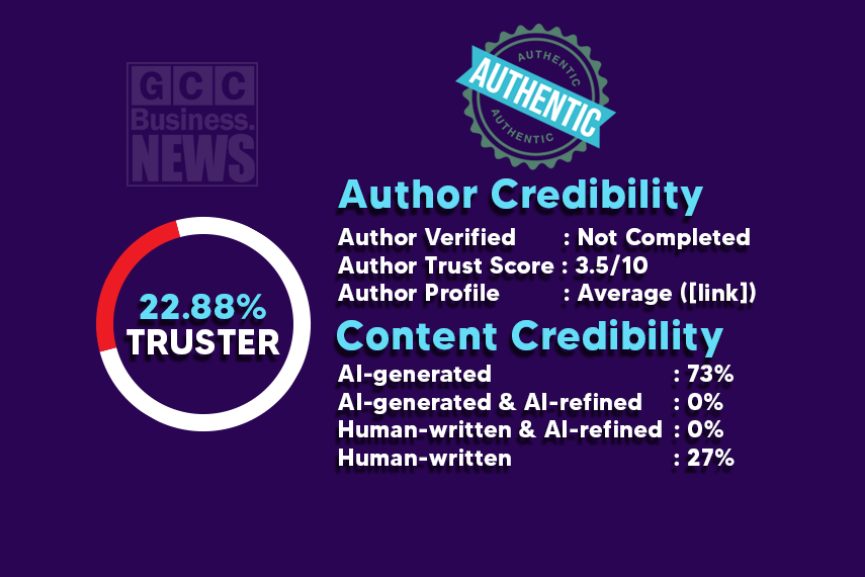
We are stepping into a better era, one where every digital content comes with a clear label. You can imagine it like this: “What you are reading now: Created by a non-expert, 90% AI generated, Credibility Score: 3/10.” Yes, as artificial intelligence keeps changing the way content is created and shared, the need for transparency is more important than ever.
The Authentic Flag is a timely and essential solution to this credibility crisis. It provides a clear system to show the origin, reliability, and method of creation for every article, image, piece of music, or video. It’s more than just a label, it’s a safeguard for truth in the age of AI.
While AI accelerates content creation and expands creative potential, it also unleashes a wave of unauthentic, unverifiable, and misleading material. In this synthetic information age, the Authentic Flag stands as a vital solution, signaling the urgent need for credibility, traceability, and transparency in everything we consume online.
Enter the concept of the ‘Authentic Flag’, a rising digital standard poised to restore trust and accountability in the way content is created, shared, and consumed online.
The Age of Synthetic Content
The proliferation of generative AI technologies has dramatically changed how we produce and engage with content. Whether it’s text, images, audio, or video, AI tools can now replicate human creativity at scale, and in seconds. While this marks a revolutionary leap for accessibility and innovation, it also presents a dangerous convergence of volume without verification.
With tools like ChatGPT, image generators, deepfakes, and voice clones readily available, the internet is increasingly saturated with content that appears legitimate but may lack factual grounding or human oversight. Studies now show that over 60 percent of users struggle to distinguish between AI generated and human-created content, leading to widespread confusion and diminished trust in digital media.
The Credibility Crisis
The blurring of lines between authentic and synthetic has contributed to what experts now call a credibility crisis, an environment where misinformation spreads faster than verified facts, and authority is harder to confirm. The consequences are far-reaching: from undermined journalism and skewed public opinion to risks in education, mental health, science, and democratic governance.
Image Source: EM’s Freepik | Edited and Designed by: GBN Design
The solution lies not in resisting technological progress, but in implementing mechanisms that signal truth, verify origin, and restore accountability, and this is where the ‘Authentic Flag’ becomes essential.
What Is the ‘Authentic Flag’?
The ‘Authentic Flag’ is not merely a symbolic term, it represents a tangible, multi-layered digital framework designed to authenticate the integrity of online content. It combines technology, policy, and ethical standards to ensure that content published on the web is transparently identified by its origin, reliability, and method of creation.
Just as websites use SSL certificates to indicate security, and social media profiles display verification badges to confirm identity, the Authentic Flag is developed to display real-time metadata about content authenticity, whether in articles, images, or videos.
In short, the ‘Authentic Flag’ is guiding us into an era where, even at the very beginning of a song, details such as AI involvement in its creation are clearly indicated.
Core Functions of the Authentic Flag
By 2030, this system is expected to offer a detailed breakdown of every content piece under the following categories:
Content Origin: Was the content fully human-written, AI generated, AI refined, or a hybrid? The flag will make this distinction clear.
Timestamp and Traceability: When and where did this content first appear online? Was it copied, altered, or repurposed?
Editorial Modifications: Has the content or media been edited after publication? Have any images been modified or manipulated?
Publisher Credibility Score: Is the website or portal a verified source? What is its historical trust rating and domain authority?
Author Verification: Does the author have recognized expertise in the subject area? If not, that lack of credentials will be clearly disclosed.
Community and Reviewer Scores: Peer feedback, review-based scoring systems, and evaluator inputs will be attached to provide a 360-degree view of content reliability.
How It Works: A User’s Perspective
Imagine reading an article about mental health. With a single click on the ‘Authentic Flag’ button displayed on the content page, you would see:
The author’s qualifications in psychology (or lack thereof)
Whether the article was AI generated or human-written
If any part of it was previously published elsewhere
Whether the images have been altered
How credible the platform is, based on independent scoring metrics
This level of transparent content tagging turns passive consumption into informed engagement, empowering readers to make decisions based on trust and traceability.
The Technology Behind the Flag
This futuristic framework will rely on an evolving combination of technologies, including:
Blockchain for Authorship Verification: Immutable records of who created what, when, and how.
Smart Watermarking: Embedding invisible yet traceable markers in AI generated content.
Content DNA Matching: A system that traces reused or reworded content back to its original source.
Real-Time Fact Layering: Overlaying live fact-checks and annotations onto articles and videos as they are consumed.
Proof-of-Humanity Protocols: Verifying whether content is human-originated through biometric and identity-based validation.
Image Source: EM’s Freepik | Designed by: GBN Design
From Policy to Practice
Governments and international bodies are beginning to support this direction. The European Union’s AI Act mandates transparency for AI generated content, and similar frameworks are being drafted in the US, Japan, and the UAE.
Tech companies are also coming on board. Platforms like YouTube, Medium, and Substack are testing experimental tags and markers for AI generated work, and major media houses are experimenting with AI disclosure statements.
The Authentic Flag is likely to evolve into a global open standard, adopted by CMS platforms, newsrooms, social networks, academic publishers, and educational portals.
The Future of News and Publishing
In journalism, the implications are particularly significant. As part of the ‘Authentic Flag’ ecosystem, news platforms will be required to indicate:
Whether a news article was originally reported or aggregated
If any part was edited after breaking
The publication’s current trust ranking across major rating boards
Whether any conflicts of interest or political biases were disclosed
Such frameworks will help users sift through the sea of headlines and focus on genuinely verified, high-integrity journalism.
Where We’re Headed
This isn’t just about fixing the problems of today, it’s about shaping a responsible internet of tomorrow. An online world where:
Authenticity is visible
Misinformation is clearly marked
Every piece of content is accountable to its origin
By turning transparency into a digital standard, we move toward a future where authentic voices are amplified, misinformation is traceable, and truth isn’t something to search for, it’s something that comes pre-tagged.
Yes, the Unchanging Serves Only Change
The internet, once anchored in static sources and assumed to be credible, is now evolving into a hyper-intelligent, hyper-dynamic ecosystem. But in this whirlwind of transformation, one principle remains constant: the human need for truth. Without clear signals of authenticity, this digital revolution risks collapsing into a wasteland of doubt.
That’s why the rise of the Authentic Flag marks more than just a technical innovation. It represents a necessary moral and cultural shift, rooted in timeless values, yet built for an ever-changing world. In an era where synthetic content can mimic form but not trust, the Authentic Flag offers a new gold standard: visible, verifiable, and human-centered credibility.
Change is inevitable, but when anchored in transparency and trust, it leads us forward. The Authentic Flag isn’t just an answer to today’s problems; it’s a foundation for a better, more accountable digital future.