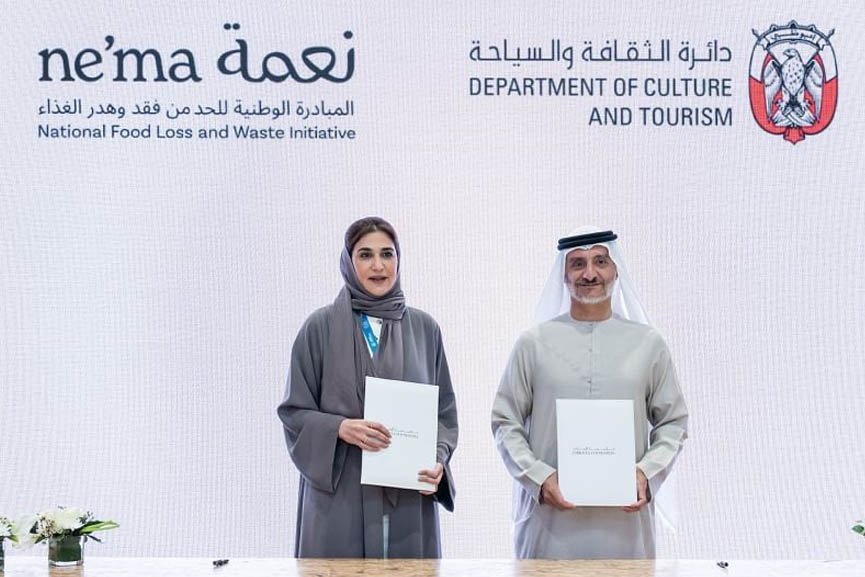
The Department of Culture and Tourism – Abu Dhabi (DCT Abu Dhabi) has signed an agreement with ne’ma, the National Food Loss and Waste Initiative, to promote responsible consumption across the tourism and hospitality sectors.
The agreement was signed by Saleh Mohammed Al Geziry, Director-General for Tourism at DCT Abu Dhabi, and Khuloud Hasan Al Nuwais, Chief Sustainability Officer of Emirates Foundation and Secretary-General of the ne’ma National Steering Committee.
The national food loss and waste initiative is at the core of the UAE’s efforts to ensure food security and address climate change, and this collaboration aims to drive transformative change in the travel and hospitality sectors, contributing to the National Food Security Strategy 2051 and the United Nations Sustainable Development Goal 12.3, aiming to reduce food loss and waste in the UAE by 50 percent by 2030.
Saleh Mohammed Al Geziry said that, “As Abu Dhabi continues to grow as a leading global destination, it is essential that we advance our commitment to sustainable development, establishing our emirate as a responsible hub for tourism and events. The partnership with ne’ma sets out a roadmap for meaningful action to reduce food loss and waste while creating awareness among travelers and stakeholders about responsible consumption.”
As part of the agreement, DCT Abu Dhabi will encourage restaurants, hotels, and tourism establishments, to adopt sustainable practices such as portion control, menu optimization, and creative use of surplus food; and develop educational campaigns for tourists and residents to highlight the environmental impact of food waste and the importance of responsible consumption.
Khuloud Hasan Al Nuwais said, “Through this collaboration, ne’ma will work with hotels, restaurants, and tourism establishments to adopt key food waste reduction initiatives such as portion control, menu optimization, and the innovative use of surplus food. ne’ma will also spearhead educational campaigns that engage both residents and tourists, emphasizing the environmental impact of food waste and the importance of mindful, responsible consumption.”
DCT Abu Dhabi will also facilitate the redistribution of surplus food to charitable organizations, food banks, or for composting, in collaboration with stakeholders across the value chain; collect data on food waste within the tourism sector to identify trends, hotspots, and areas for improvement, thereby informing future strategies; and promote broader sustainability initiatives, including reducing single-use plastics, supporting local food producers, and minimizing transportation-related emissions.