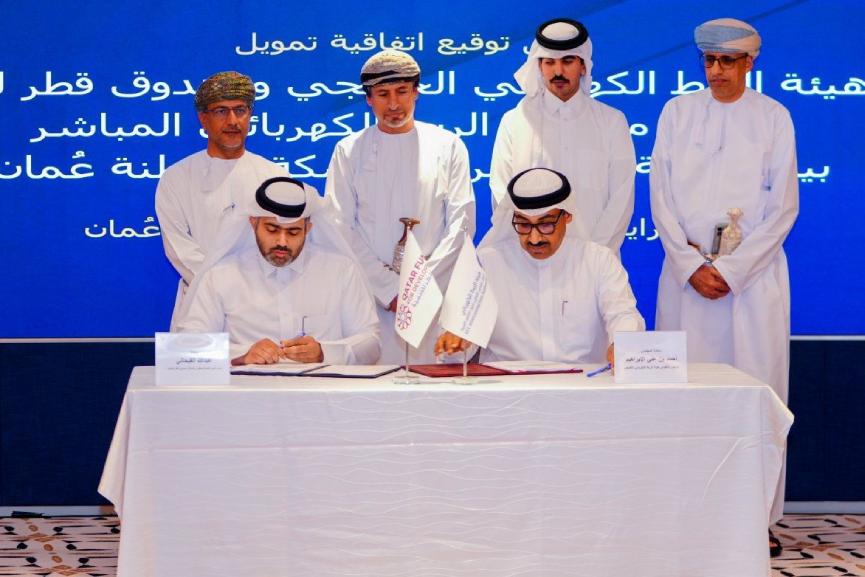
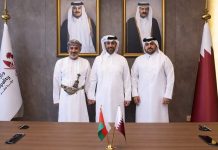
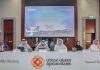
The Gulf Cooperation Council Interconnection Authority (GCCIA) and the Qatar Development Fund (QDF) have formalized their partnership in a landmark financing agreement, for Oman grid connection project.
This agreement paves the way for a transformative direct grid connection project linking the GCCIA network with the Sultanate of Oman. The auspicious signing ceremony was graced by the presence of His Excellency Mohsin Al Hadhrami, Undersecretary of the Ministry of Energy and Minerals and Chairman of the Board of Directors of the GCCIA, and His Excellency Sheikh Mubarak bin Fahad Al Thani, Ambassador of the State of Qatar to the Sultanate of Oman.
The agreement was duly executed by His Excellency Eng. Ahmed Ali Al-Ebrahim, CEO, on behalf of the GCCIA, and by His Excellency Fahad Hamad Al Sulaiti, Director General, on behalf of the Qatar Fund for Development, during a ceremony held today in Muscat.
The direct grid connection project involves the construction of two 400 kV overhead transmission lines connecting the GCCIA’s Al Sila station in the United Arab Emirates to the Ibri station, which the GCCIA will construct in the Sultanate of Oman. The total length of the lines will be 530 kilometers.
The project also includes the construction of two 400 kV substations, one in Ibri and the other in Al Baynunah. These substations will be equipped with advanced control, protection, and communication systems to ensure reliability, efficiency, and safety.
A dynamic compensator station will also be installed to bolster grid stability and increase transmission capacity. This interconnection project will provide a total transmission capacity of 1,700 MW, with a net transfer capacity of 1,200 MW.
This project marks a pivotal stride toward the seamless integration of Gulf power grids, a vital strategic initiative designed to fortify regional energy network connectivity and bolster the reliability and sustainability of the region’s electricity systems. It resonates with global imperatives for energy infrastructure development and the pursuit of sustainable development goals.
Furthermore, it will streamline and amplify electricity exchange between the GCC countries and Oman, fostering greater flexibility and resilience within regional power systems. Operational costs will also see a marked decrease, as the interconnected network reduces the operational expenditures of participating nations, leading to substantial annual financial savings. Critically, this initiative will contribute significantly to the reduction of carbon emissions, directly supporting global environmental conservation efforts.
His Excellency Engineer Salim Al Aufi, Minister of Energy and Minerals, underscored the strategic significance of this agreement, positioning it as a key element within the framework of Gulf integration policies in the energy sector. He highlighted the project’s role in bolstering energy security and sustainability, noting its synergy with GCC initiatives to develop a high-performing and dependable energy infrastructure.
His Excellency Mohsen bin Hamad Al Hadrami, Undersecretary of the Ministry of Energy and Minerals and Chairman of the Board of Directors of the Gulf Cooperation Council Interconnection Authority (GCCIA), affirmed that the electrical interconnection project stands as a cornerstone among the vital infrastructure initiatives endorsed by the leaders of the GCC states.
The GCCIA’s interconnection network has proven its mettle, preventing over 2,800 electrical outages in member states through the instantaneous transmission of required power across the interconnection network. Since the commencement of operations, the network has been a bulwark against power disruptions.
His Excellency further stated that the GCCIA is committed to ensuring that the electrical interconnection network keeps pace with the growing demands of power grids across all GCC member states. To this end, the Authority has prioritized the expansion and modernization of electrical linkages both within and between member states, culminating in the implementation of several key network expansion projects, including the direct connection with the Sultanate of Oman.
These endeavors will augment the capacity of the GCC-wide electrical interconnection network, thereby bolstering the ability of member states to manage power contingencies.
H.E Eng. Ahmed Al-Ebrahim, CEO of the GCCIA, highlighted the project’s transformative potential, noting that its construction is slated to begin in the second half of 2025, with commissioning planned for the first half of 2027. Al-Ebrahim emphasized that it will significantly bolster grid stability, reducing the disruptive effects of major outages and ensuring uninterrupted power supply under various conditions.
Fahad Hamad Al Sulaiti, General Manager of the Qatar Development Fund, highlighted the agreement as a testament to the Fund’s commitment to driving economic growth in Arab and developing countries through targeted financing and loans for development initiatives. Rooted in a shared understanding of regional cooperation’s vital role, this initiative recognizes energy as a linchpin of stability and socio-economic advancement.
This project embodies the Qatar Development Fund’s enduring dedication to forging regional partnerships and spearheading sustainable development efforts, paving the way for a brighter future.