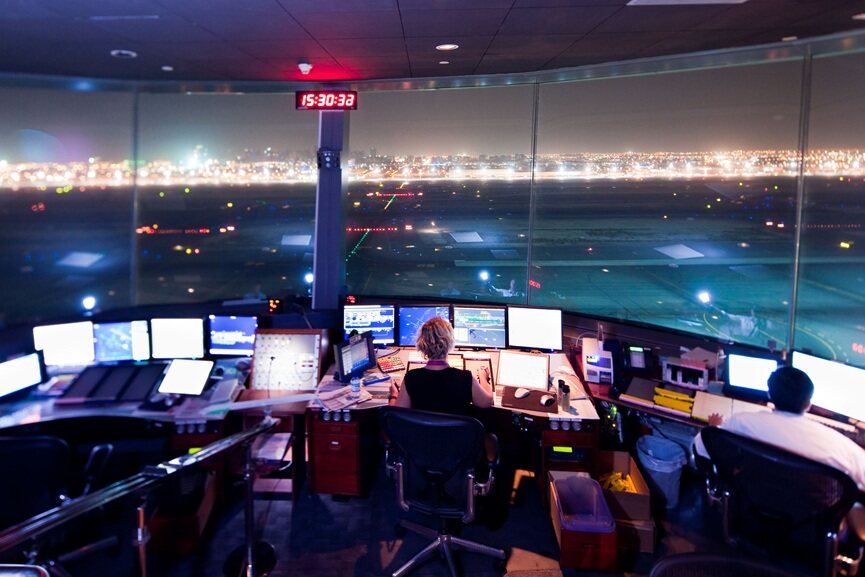
Airports in the Middle East, Africa, and South Asia (MEASA) have invested heavily in modernizing Air Traffic Management (ATM) and Air Traffic Control (ATC) systems, using AI, ML, and Big Data to boost safety and efficiency.
The region’s 110 airports, including major hubs in the UAE, are transforming their infrastructure to sustain competitiveness and technological leadership.
Airport infrastructure modernization
Cutting-edge ATM and ATC solutions will be showcased at the 25th Airport Show, held at the Dubai World Trade Centre (DWTC) from May 12–14, 2026, with over 150 exhibitors from 30 countries expected to attract more than 7,000 visitors.
Co-located conferences will include the Global Airport Leaders’ Forum (GALF), Airport Security Middle East, Air Traffic Control (ATC) Forum, and Women in Aviation (WIA) Middle East Conference, with the ATC Forum running for its ninth consecutive year.
Ibrahim Ahli CEO dans
“Rapid aviation growth, fleet modernization, and rising connectivity are placing unprecedented demand on Air Navigation Service Providers. By integrating AI and digital tools into ATM, we are delivering a safer, more efficient, and cost-effective service, aligned with Dubai’s strategic aviation growth.”
AI and big data transform air traffic operations
Dubai Air Navigation Services (dans) is actively advancing AI applications to reduce holding patterns, optimize flight paths, and improve airspace management at Dubai International Airport (DXB) and Al Maktoum International Airport, which is undergoing a $35 billion expansion to handle 260 million passengers by the mid-2030s.
The authority is also upgrading Communication, Navigation, and Surveillance (CNS) systems and implementing advanced runway capacity concepts such as Dependent Diagonals.
The surge in global air travel, expected to reach 5.2 billion passengers in 2026 and 17.7 billion by 2043, is driving airports to adopt advanced digital solutions to manage increasingly dense air traffic.
Passenger traffic in the Middle East alone is projected to exceed 240 million in 2026, prompting significant upgrades in ATM systems to optimize aircraft spacing, monitor airspace safety, and improve operational efficiency.
AI integration is already demonstrating measurable impact: in Europe, predictive models have reduced air traffic delays by 18 percent, while in the US, AI decision-support tools improved controller response times by 22 percent.
The International Civil Aviation Organization (ICAO) reports a 25 percent decrease in unexpected system failures due to AI-driven analytics, ensuring smoother operations and enhanced passenger experiences.
The global ATM market is projected to reach $10.96 billion in 2026 and $21.24 billion by 2034, with worldwide commercial air traffic and fleet growth placing increasing demands on airport systems.
By 2043, aircraft movements are expected to reach 149 million annually, underscoring the urgent need for intelligent, technology-driven ATM solutions.