With the market for new brands and innovative products gaining momentum, entrepreneurs are seeking faster, lower risk ways to enter the market.
This transition is both natural and innovation driven. In this context, the article offers readers a foundational perspective on how emerging models such as white labeling, private labeling, OEM and ODM manufacturing, and dropshipping can be strategically leveraged.
FMCG market and potential
The global fast-moving consumer goods (FMCG) market was valued at an estimated $13-15 trillion in 2024-2025, driven by population growth, urbanisation, expanding eCommerce, and rising demand for convenience and health-focused products. Industry projections indicate the market could exceed $20 trillion by the early 2030s, supported by steady annual growth and the rapid expansion of Asia-Pacific economies led by India and China. Across electronics, personal care, food, fashion, and home goods, hundreds of new brands now enter the market every day.
Rising incomes, a growing young population, widespread digital adoption, and increasingly entrepreneur-friendly ecosystems continue to reinforce this momentum. Market entry is no longer limited to industrial giants. A focused product concept, credible packaging, a professional digital presence, disciplined branding, clear storytelling, and reliable customer service now allow even small teams to compete, provided core business fundamentals are properly structured.
Only about 10 percent of global brands operate as fully integrated manufacturers, controlling research, design, engineering, quality systems, and production. This reality lowers traditional entry barriers and opens strategic pathways into competitive markets. In a projected $20 trillion FMCG economy, even a 0.00001 percent market share represents a $2 million revenue opportunity, illustrating how small, well-executed positions can scale into meaningful businesses.
Image: EM’s FP | Reworked by GBN internal team
Industry observers estimate that a large majority of consumer brands rely on outsourced manufacturing models, often sharing production partners with competitors. Differentiation frequently comes down to branding, packaging, pricing strategy, and market positioning rather than deep product innovation. This structural shift is reshaping how products are created, priced, regulated, and trusted across global markets.
Outsourced models and market entry
Across global consumer industries, outsourced manufacturing models have become the dominant pathway for brand creation. Instead of investing heavily in factories, laboratories, engineering teams, and regulatory infrastructure, many companies now rely on established production partners to reduce capital exposure and shorten time to market.
One of the most common approaches is white labelling and private labelling, where companies purchase finished products from factories and apply their own branding. The same base product can appear under multiple brand identities across different regions and online platforms. This model is widely used in food, personal care, household goods, and consumer accessories across the GCC because of its speed and scalability.
OEM and ODM manufacturing allow brands to request limited customization of existing factory designs, such as changes in features, materials, performance specifications, or packaging, while the factory retains ownership of the underlying product architecture. Electronics, appliances, automotive accessories, and smart devices frequently operate under this structure, enabling faster product launches without long development cycles.
Dropshipping and import-distribution models further reduce operational friction by eliminating inventory ownership. Brands focus on marketing, customer acquisition, and order management, while manufacturers or logistics hubs ship directly to consumers. As regional fulfilment networks and cross-border eCommerce platforms mature, this model has become increasingly viable across the Middle East.
In co-packing, contract manufacturing, licensing, and assembly outsourcing, brands may control formulation, branding, or market strategy, while production, compliance, and scaling are handled by specialized partners. These models are especially common in food processing, cosmetics, supplements, and packaged goods, where regulatory complexity and batch scalability favour shared infrastructure.
Together, these approaches significantly reduce entry barriers. Entrepreneurs can launch brands in months rather than years, deploy limited capital, and outsource much of the operational complexity. The GCC’s logistics hubs, free zones, and digital trade infrastructure has further strengthened this dynamic, enabling startups to access regional and international markets with increasing efficiency.
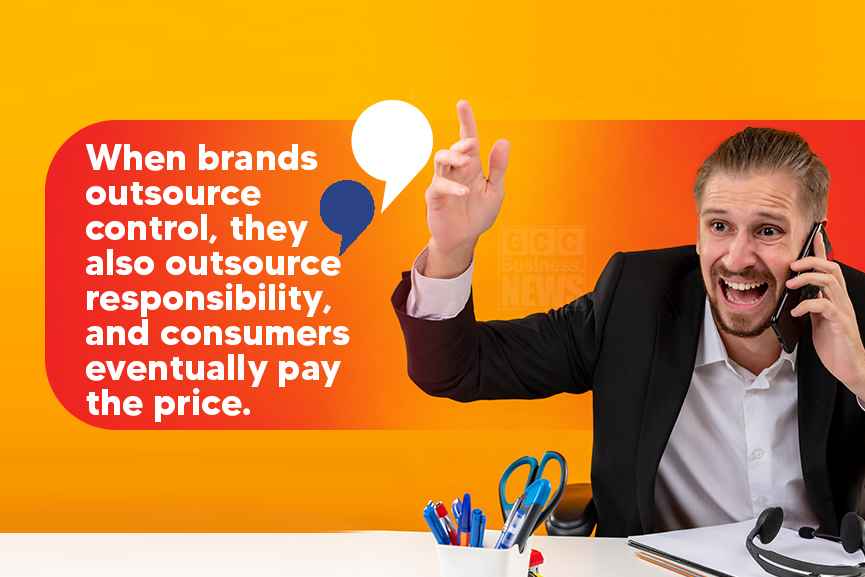
While these models accelerate access and flexibility, they also redefine where responsibility and control ultimately reside within the value chain.
Brand vs Manufacturer divide
Image: EM’s FP | Reworked by GBN internal team
A fully integrated manufacturing brand maintains ownership of product development, engineering validation, quality systems, supplier audits, and production traceability. This structure supports tighter control over safety, consistency, regulatory compliance, and long-term innovation.
By contrast, many outsourced brands function primarily as marketing and distribution entities. Factories serving multiple clients often influence design decisions, material sourcing, production methods, and cost trade-offs. When quality issues arise, accountability can become fragmented, slowing corrective action and eroding consumer confidence.
This dynamic is increasingly visible in sectors such as electronics, wellness products, automotive accessories, beauty devices, and nutritional supplements, where performance expectations and regulatory scrutiny continue to rise.
Why outsourcing keeps expanding
The growth of eCommerce platforms, cross-border logistics, digital advertising, and influencer-driven discovery has significantly reduced the cost of market entry. Consumers often prioritise convenience, aesthetics, social proof, and price competitiveness over manufacturing provenance, reinforcing the attractiveness of asset-light brand models.
For early-stage companies, building factories, laboratories, and compliance infrastructure is often financially unrealistic. Outsourcing allows founders to test demand before committing serious capital. Investors also tend to favour scalable models that demonstrate faster revenue growth and operational flexibility.
In the GCC consumer market, expanding digital retail ecosystems, modern logistics corridors, and government-led entrepreneurship initiatives continue to strengthen the region’s appeal as a launch platform for consumer brands.
Risks for consumers and markets
The rapid expansion of outsourced branding introduces structural risks. Markets are increasingly saturated with look-alike products that offer limited transparency on manufacturing origin, material quality, testing standards, and lifecycle responsibility. Price competition intensifies while differentiation weakens.
Regulatory enforcement struggles to keep pace with fragmented, cross-border supply chains, particularly within online marketplaces where traceability remains limited. This environment increases exposure to recalls, counterfeits, misleading claims, and inconsistent product performance, challenging long-term consumer trust.
Genuinely responsible manufacturers often find it difficult to stand out amid crowded digital shelves dominated by branding-driven competition.
Shift toward transparency
Image: EM’s FP | Reworked by GBN internal team
Regulators, platforms, and consumers are gradually demanding clearer disclosure of manufacturing origin, certification standards, and supply chain accountability. Some brands are responding by investing in partial vertical integration, proprietary design ownership, independent testing, and traceable sourcing.
Digital verification systems, serialized product identity, QR-based transparency tools, and third-party audits are increasingly viewed as operational trust infrastructure rather than optional marketing features.
Over time, markets are likely to reward brands that demonstrate operational responsibility and transparent governance rather than surface-level branding alone.
Natural and expected challenge
For any new brand entering the market, the primary challenge is earning consumer trust and establishing authenticity. Customers naturally question whether an unfamiliar brand is reliable and credible. The most sustainable way to overcome this barrier is through disciplined, consistent customer service. A seamless and responsive customer experience does not merely support growth, it forms the foundation for credibility, market acceptance, and long-term business performance.
Brutal reality
Modern branding has become easier to launch but harder to trust. Outsourced models accelerate access and innovation while blurring accountability and diluting differentiation.
For entrepreneurs, the opportunity remains substantial, but sustainable success increasingly depends on disciplined execution, operational transparency, and long-term credibility.
For more informed consumers, investors, and policymakers across the GCC and beyond, understanding how products are actually made, and who truly controls quality, credibility, and brand power, is becoming increasingly important alongside marketing and pricing considerations.