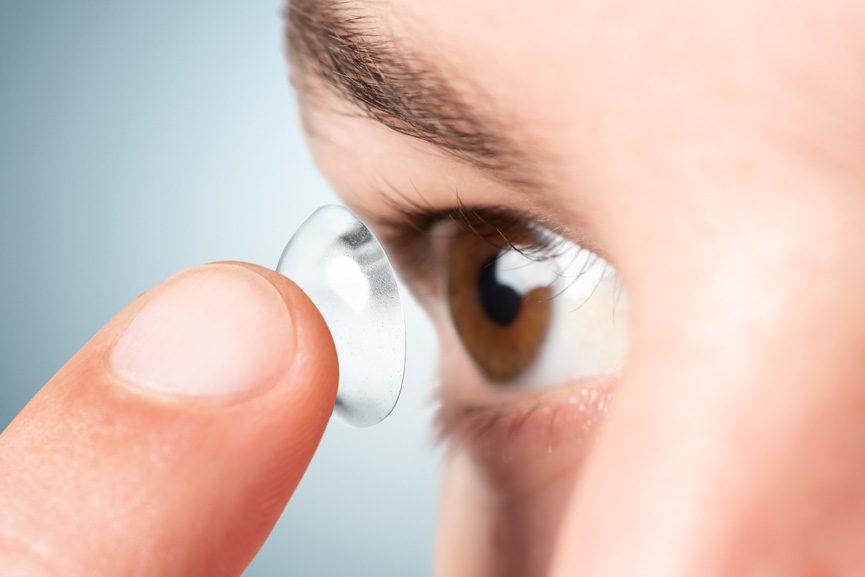
An international team of researchers led by Chinese scientists has developed innovative contact lenses that allow users to see near-infrared light, a scientific breakthrough that could significantly impact medical imaging and visual aid technologies.
The development marks a major step forward in wearable optics, with potential applications ranging from enhanced diagnostic tools to next-generation assistive devices for the visually impaired.
The study, published in the journal Cell, combines visual neuroscience with rare earth elements to create transparent, wearable lenses that convert invisible infrared light into visible images.
The human eye is naturally limited to perceiving light within the visible spectrum, wavelengths ranging from 400 to 700 nanometers, leaving much of the electromagnetic spectrum, and valuable natural information, unseen.
In contrast, near-infrared light, which spans wavelengths from 700 to 2,500 nanometers, can penetrate biological tissue effectively while causing minimal radiation damage, making it ideal for applications such as medical imaging and diagnostics.
Researchers from the University of Science and Technology of China, Fudan University, and the University of Massachusetts Medical School engineered rare earth elements that transform three different infrared wavelengths into red, green, and blue visible light.
According to the statement, “Previously, scientists in the team developed a nanomaterial that, when injected into animal retinas, enabled mammals to see near-infrared light naturally. Since retinal injections aren’t practical for humans, they started to design a wearable, non-invasive alternative using soft contact lenses.”
Modified Nanoparticles Key to Infrared Contact Lenses
The research indicates that the team modified the surface of the rare earth nanoparticles, enabling them to be dispersed in polymer solutions and ultimately fabricate highly transparent contact lenses.
Human volunteers wearing the lenses could identify infrared patterns, temporal codes and even distinguish three different ‘colors’ of infrared light, essentially expanding the human visual spectrum beyond its natural limitations. The non-invasive technology has potential applications in medical imaging, information security, rescue operations, and treating color blindness.
Contact Lenses Mimic Night Vision
As per the statement, “Unlike night vision goggles, the contact lenses, capable of enhancing vision in low-visibility conditions such as fog or dust, require no power source and provide a more natural visual experience. While still at the proof-of-concept stage, the researchers believe the technology could eventually help people with visual impairments and revolutionize how humans interact with the invisible light spectrum.”