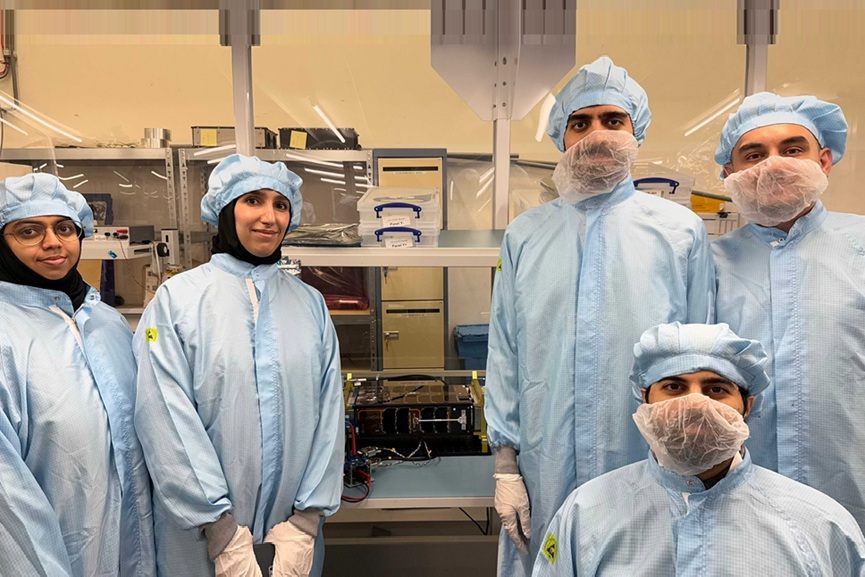
A delegation from the Sharjah Academy for Astronomy, Space Sciences and Technology (SAAASST) at the University of Sharjah has begun the final testing phase of Sharjah Sat-2 during a recent visit to the Netherlands, marking a key milestone in the CubeSat mission’s development.
The delegation conducted an on-site visit to Innovative Solutions in Space, known as ISISPACE, a company specializing in the development and integration of CubeSats and advanced space systems.
The visit formed part of ongoing work on Sharjah Sat-2, which is being developed by the SAASST’s CubeSat Laboratory in partnership with several national entities, including Sharjah Municipality, the Department of Planning and Survey, and the Sharjah Electricity, Water and Gas Authority.
The Sharjah Sat-2 focused on the final and most critical stages of assembly, integration, and testing ahead of launch. Engineers conducted functional and environmental tests, verified subsystem integration, assessed power systems and safety modes, evaluated communications for reliable command and data transmission, and confirmed flight software readiness, ensuring full operational capability ahead of the planned first-quarter 2026 launch.
The visit also included inspections of ISISPACE’s testing facilities, including the thermal vacuum chamber that simulates extreme space conditions and vibration systems that replicate launch stresses to validate structural integrity and component stability.
In addition, the SAAASST delegation held technical coordination meetings with system engineers, attended a workshop on IPC manufacturing and inspection standards, and reviewed quality assurance procedures covering inspections, component acceptance, and documentation, confirming the satellite’s readiness to move to the next project phase.
Sharjah Sat-2
Sharjah Sat-2 is a 6U Earth observation CubeSat developed by SAAASST, with ISISPACE as integrator, to deliver high-resolution hyperspectral imagery for planning and research focused on Sharjah. Built with local partners, the satellite is designed for a three-year mission.
Image credits: SAASST | Cropped by GBN
Equipped with a multispectral imaging camera for Earth observation and natural resource studies, Sharjah Sat-2 is capable of capturing high-resolution images with a spatial resolution of up to five meters. The data generated will support Sharjah’s initiatives in urban planning, environmental monitoring, natural resource management, and emergency and disaster response.
The mission will also contribute to sectors such as sustainable agriculture and coastal protection, while strengthening national capabilities in space technology and advancing the development of local scientific expertise.